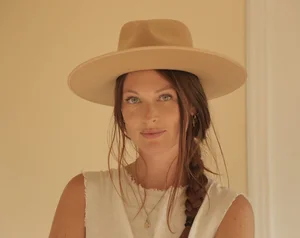
On resilient sanctuaries, household sovereignty, and why I think our homes will need to do more than shelter us in the years ahead.
Surprise. Underneath the clay plaster and beautiful linens, there’s a woman thinking about water storage and escape routes.
I think it’s time I come out as a prepper.
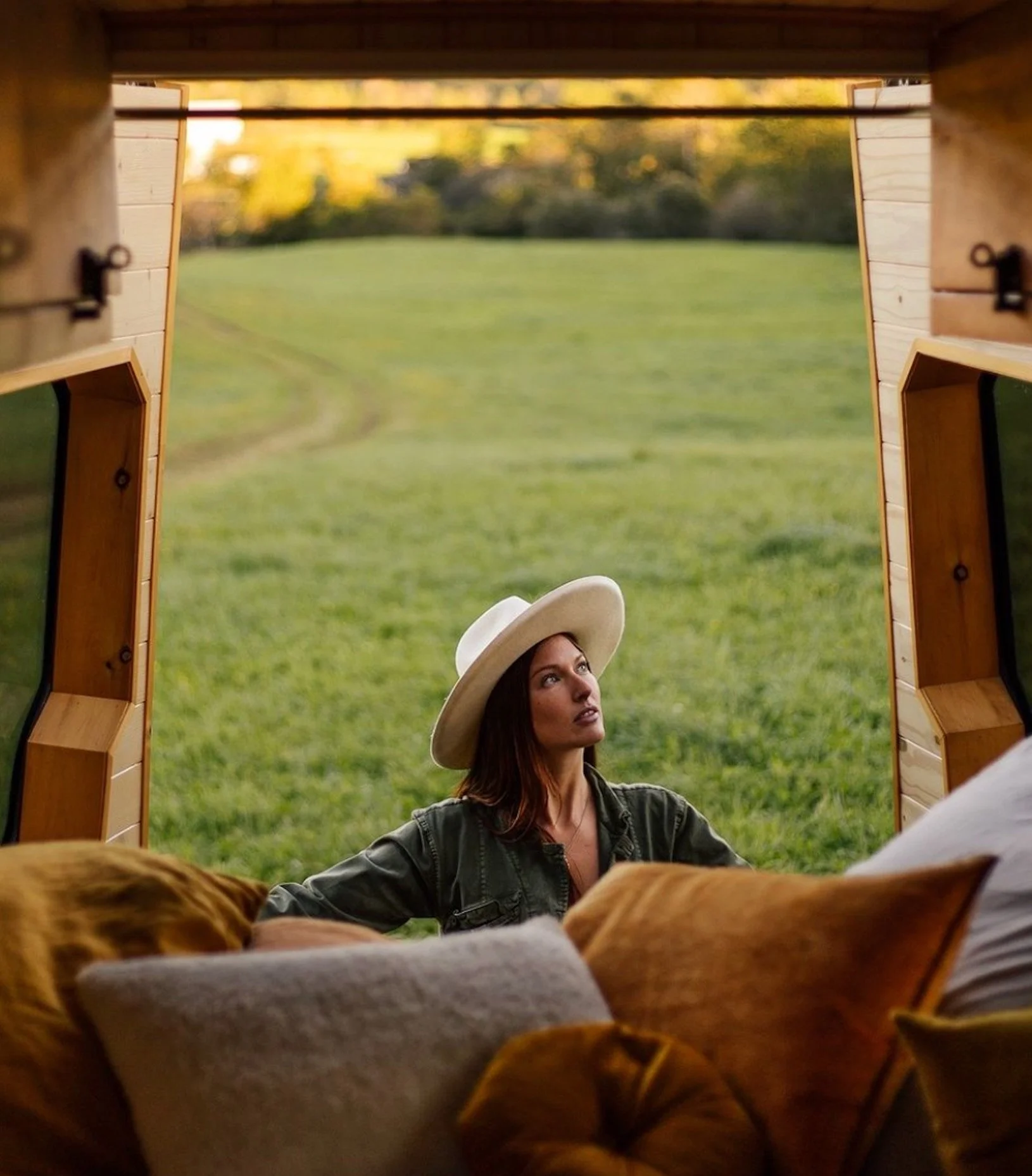
Not a particularly hardcore one. I don’t have an underground bunker or a lifetime supply of canned beans.
I like to think I’m good at looking normal and playing it cool.
But I do own a hand-crank radio. And a ham radio. I get unusually excited about manual tools and redundant systems. I like to keep months’ worth of dry goods on hand. I chose my land partly for its water sources, forest and south-facing slope. And somewhere amongst the luxurious cherry cabinetry, organic linen sheets, hot water tiled shower, feather duvet and full-length mirror in my campervan are water filtration equipment, a sump pump, solar power and enough infrastructure for me to live comfortably off-grid.
I am, apparently, a bougie (and unsuspecting) prepper.
Nobody can tell from looking at me.
And lately, I’ve been leaning into it more.
As I prepare to leave home for the winter, as the young snowbird that I am, I’m upgrading the van again: more food storage, a rack for my e-bike, more ways to make this little home on wheels resilient and adaptable.
Because I prepare.
I have been preparing, in different ways, for more than a decade.
And I think I’m finally ready to talk about why.
I used to think photographs couldn’t lie
Before I designed sanctuaries, worked with clay or knew anything about passive solar design, I wanted to be a photojournalist.
I was fascinated by politics, photography and the idea of documenting what was actually happening in the world. At the time, I genuinely believed there was something inherently truthful about an image. You could manipulate words, I thought, but a photograph showed you what was there.
This was before our current era of AI-generated realities, of course. But it was also before I understood how much power exists in simply deciding what gets photographed, what gets published, what gets omitted, and how a story gets framed.
I went through an intensive communications program in CEGEP, taught largely by people who also worked professionally in media and journalism. And what I learned there deeply challenged my romantic ideas about journalism.
I learned firsthand how framing, ownership, commercial incentives, editorial choices and institutional interests can influence what eventually becomes the story.
I became disillusioned enough that when I went to university, I chose political science alongside photography. I wanted to understand the systems themselves rather than simply learn how to report on them.
At the same time, I found my way into jewelry and fashion. Sustainability was already becoming central to my work, and I became one of the voices in my Montreal circles pushing conversations about more responsible materials and practices.
But something still felt insufficient.
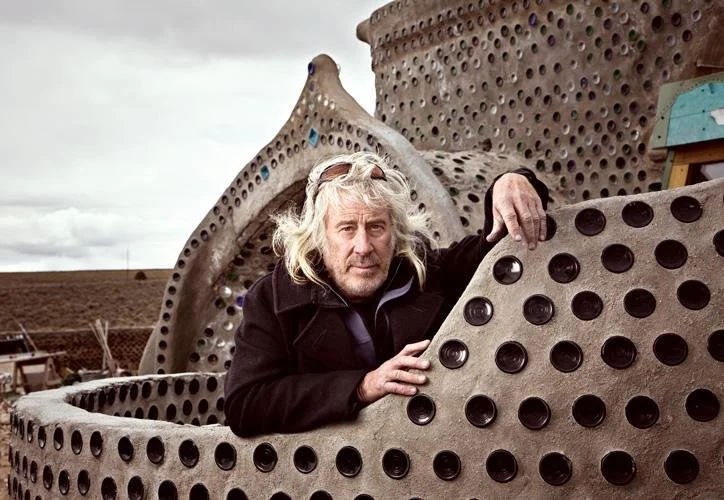
Then, sometime around 2011, my then-boyfriend showed me a documentary called Garbage Warrior.
I
t followed architect Michael Reynolds and his decades-long work developing Earthships: radically self-sufficient homes designed around things like passive solar, thermal mass, water harvesting and reused materials.
There was an image in that film that never left me.
Humanity as a herd of buffalo running toward the edge of a cliff.
And Reynolds asking, essentially: How do you turn the herd?
Something clicked.
I had been thinking about sustainability through the things we bought and wore. Suddenly I was thinking about the places where we spend almost our entire lives; our homes.
How we build them. What we build them from. How much energy they require. Where the materials come from. Whether they make us sick or keep us well. Whether they work with their landscape or require enormous systems to extract from the natural world to keep them functioning.
I started asking a different question:
How can I truly embody this reality so I can inspire people to live differently?
That question eventually changed the trajectory of my life.
My first sovereign sanctuary had wheels
By 2018, one of the answers had become a campervan.
I designed and outfitted it myself, with help from my dad’s friend François on the electrical and plumbing systems. And from the beginning, I knew exactly what I wanted it to be.
Not a janky van I could tolerate living in.
A sanctuary.
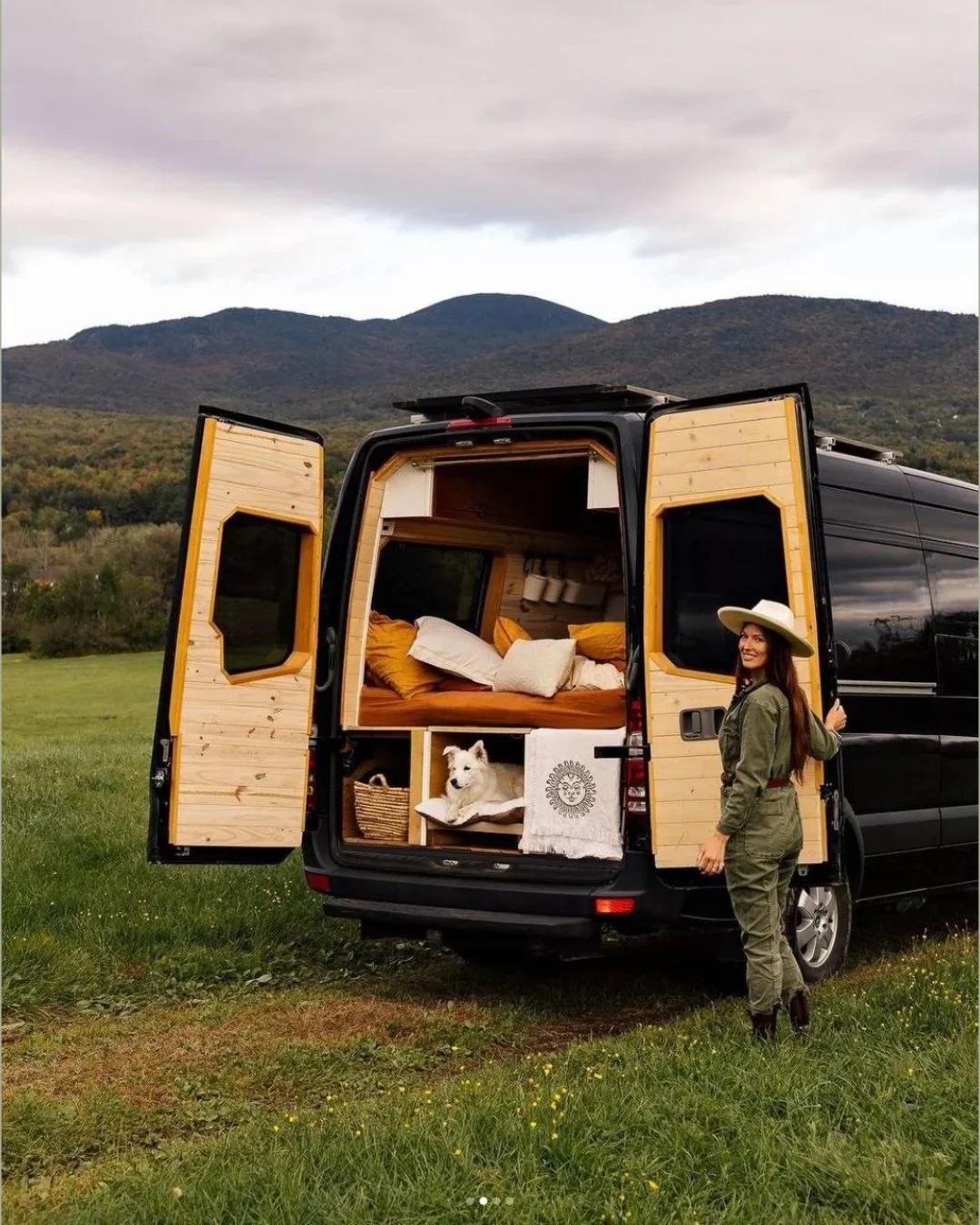
My moving Sanctuary
Survival and beauty do not have to be opposing values.
My batteries can be charged three ways: solar, the vehicle's engine or shore power. I can cook, stay warm and charge my devices independently from the electrical grid. I carry equipment for accessing and treating water, alongside food, tools and other essentials. I deliberately keep manual tools because I don't want every useful object I own to become useless when a battery dies.
And perhaps most importantly, I can move.
As a woman who has travelled extensively alone, that matters enormously to me.
I specifically chose a van rather than a trailer because I never wanted to have to step outside my home in order to leave. If something doesn't feel right, I can climb into the driver's seat and go.
I've only needed that ability a handful of times. But knowing it exists changes how I move through the world.
Even now, I notice that I feel slightly uneasy when the van is thousands of kilometres away from me.
It's more than a vehicle.
It's my safety piece.
Because underneath my interest in food storage or solar power is something much more fundamental:
I am deeply uncomfortable with being trapped. With having nowhere to go. With having all of my options controlled by something (or someone) outside of me.
The van means I have options.
And one particular day showed me just how much those options could matter.
The day the power went out
In May 2022, I was taking a course in the Laurentians when an enormous storm tore through the region.
I remember everyone suddenly running toward the windows.
Class essentially stopped.
The noise outside was extraordinary. The wind felt violent. This wasn't weather we were accustomed to seeing there.
When we finally stepped outside, enormous evergreen trees were splayed across roads. Massive, mature trees. Power lines were down. Roads were blocked. I passed several houses where trees had come down crushing roofs. At one of them, I stopped to make sure the people inside were okay.
I was supposed to visit my friend Stéphanie nearby after class.
She had given birth only a few months earlier. Her partner worked in Northern Québec and was away, so she was home alone with her new baby when the power disappeared.
Getting to her was complicated because so many roads were obstructed, but eventually I made it.
Another girlfriend, Elisabeth, joined us.
And what I remember most about that night isn't fear. It's how much fun we had!
Three women, a newborn baby, trees down everywhere, electricity out… and this little house on wheels sitting outside with its own power.
We cooked ourselves a delicious meal. We played music. We were warm.
We were comfortable. We had a jolly old time.
The world immediately around us had become temporarily less predictable, but inside our little sphere, life continued.
A disruption happened outside, and because somebody had options, life inside could remain warm, connected, fed and even pleasurable.
That night crystallized something for me.
Preparedness isn't only about making sure I will be okay. Resilience creates capacity.
When I have enough, know enough and can adapt enough, I have more ability to care for the people around me too.
I don't need you to believe what I believe
Yet I think we can agree that we're living through a period of profound change.
And I prepare because I believe the coming years will ask us to become more resilient, more resourceful and more connected to the places and people immediately around us.
You don't have to share every conclusion I've reached about where the world is heading.
I don't actually need you to believe what I believe.
BUT, I do want you to become harder to render helpless.
For me, that means decentralizing some of my attention away from enormous systems I have very little ability to influence and bringing it back toward the sphere directly in front of me.
My home. My land. My skills. My food. My water. My people. My ability to respond.
That doesn't mean becoming completely self-sufficient. In fact, I think our obsession with individual self-sufficiency can miss something essential.
I'm not an island.
I don't need one of every farm animal, every vegetable, every machine and every skill on my property. My neighbours have cows. Other people have chickens. Someone else grows potatoes. Someone knows engines. Someone has equipment I don't have. Someone knows things I don't know.
The interesting question isn't How do I make sure I never need anybody?
It's:
What do I bring to the ecosystem?
What can I grow, build, repair, teach, lend, preserve, make or share that somebody else might need?
Because diversity creates resilience.
We understand this intuitively in ecosystems. A healthy forest isn't made of one species of tree. Its strength comes through relationships: different organisms doing different things, occupying different niches, exchanging resources, responding differently to stress.
Why would resilient human communities be any different?
Maybe one neighbour has the legendary basement full of toilet paper. Great, power to them! I might need toilet paper one day.
The important thing is that I have something they'll want in return.
Designing a resilient sanctuary
This is where preparedness becomes part of sanctuary design for me.
A sanctuary isn't simply a beautiful room that regulates your nervous system when everything outside is going well.
A sanctuary should know how to hold you when things aren't.
You don't need an Earthship, eight acres or a campervan to begin.
Start by looking at your home differently.
Build redundancy
One way to do something is convenience.
Two or three ways begin to create resilience.
How do you heat your home? Cook? Access water? Communicate? Get somewhere? Charge what genuinely needs charging?
You don't need three elaborate systems for everything. Simply begin noticing your single points of dependence.
My van has three ways of charging its batteries because I don't know which one will be available when I need it.
That principle scales.
Know your home
Learn where your water shutoff is.
Understand your electrical panel.
Know how your heating system works.
Own some basic tools—and know how to use them.
Understand what your home requires to remain habitable and which of those systems stop working when the electricity does.
Knowledge itself is infrastructure.
Keep a buffer
Canadian emergency guidance recommends that households be capable of taking care of themselves for at least 72 hours.
I personally prefer a much deeper buffer, particularly with shelf-stable food. That's my own preparedness threshold, not a universal prescription.
Start where you are.
Three days is better than none. A week is better than three days.
What matters is building gradually enough that preparedness supports your life rather than becoming another source of fear.
Keep some things low-tech
I love technology.
I also love an axe.
I have solar panels and battery banks, and I have a manual pasta maker.
Some of the most resilient technologies humans have ever created are incredibly simple.
Keep tools around that still know how to be tools when the Wi-Fi is gone.
Build skills, not only stockpiles
Supplies eventually run out.
Knowledge travels with you.
Learn to cook from basic ingredients. Mend something. Grow something. Preserve something. Build something. Repair something. Learn your landscape. Learn basic first aid. Understand how to improvise with what you already have.
The objective isn't to become an expert in everything.
It's to slowly become more capable.
Know where you live
I chose my property knowing that it was a homestead in becoming.
It isn't off-grid. It isn't remotely the finished vision.
But the land has many of the bones I wanted: a south-facing slope, natural water, forest, wood for heat, space to grow food and an orientation that could eventually support passive-solar construction.
Pay attention to your own place.
Where does the sun travel in winter?
Where does water move?
What grows without your help?
What resources already surround you?
What are the particular vulnerabilities of your climate?
A resilient sanctuary doesn't exist separately from its landscape.
It belongs to it.
Know your people
This might be what matters most.
Know your neighbours.
Know who you could call. Know who might call you.
Share tools. Trade skills. Grow different things. Check on the person who lives alone. Bring dinner to the new mother whose electricity just disappeared.
Preparedness without community can become isolation.
Preparedness within community becomes resilience.
And please, keep it beautiful
I mean this seriously.
I don't want to survive inside a bunker if I can help it.
I want good food.
Warm floors.
Natural materials.
Music.
Soft bedding.
Sunlight.
Things that smell wonderful.
People I love around the table.
I want resilience in service of life—not life in service of preparing for everything that might go wrong.
The ancient future
If I could build the full expression of my resilient sanctuary tomorrow, I know what it would feel like.
A natural home made from hemp and clay, with thick walls, rounded edges and the sensuality of places I've loved in Greece, Mexico and Morocco.
Large south-facing windows.
Passive solar.
Warm floors.
Tadelakt.
A greenhouse for extending the growing season.
Water on the land.
Animals moving through it.
Horses wandering up toward the house.
The smell of hinoki, sandalwood, palo santo or sweetgrass depending on the season.
Food growing nearby.
Useful tools.
Good systems.
And people around me who know things I don't!
It would be technologically intelligent where technology genuinely serves life and beautifully low-tech where humans already figured out the better solution centuries ago.
This is what I mean when I talk about the ancient future.
Not going backward, but remembering what worked, carrying forward what still serves us, and becoming much more discerning about what we choose to depend upon.
Maybe my version of prepping is to remain adaptable, to have options, and to care for myself well enough that I still have something left to offer someone else. Preparing a home that can shelter more than my body.
A home that can sustain life.
This guide is meant for the home makers of the ancient future who wish to empower themselves in creating a healthier, more generative home for them & their families
This 31-page guide will help demystify sustainable and healthy homes, and give simple & easy shifts you can implement today, for free, to get there.
This product includes:
What is an ecological home?
Certifications
Different types of sustainable homes
Interior design hacks
In-depth scan of the home through the lens of the different senses, with guides on what to incorporate or ditch (see, smell, hear, touch, feel)
Air quality hacks
This product will help you to...
Gain education on what is actually healthy and not
Discern what is empowering and resourcing you, versus what may be depleting you and your family
Make conscious design choices for yourself and the planet
Make your home a sanctuary so you can cultivate a regenerative way of living in a way that supports your well-being and fuels your purpose